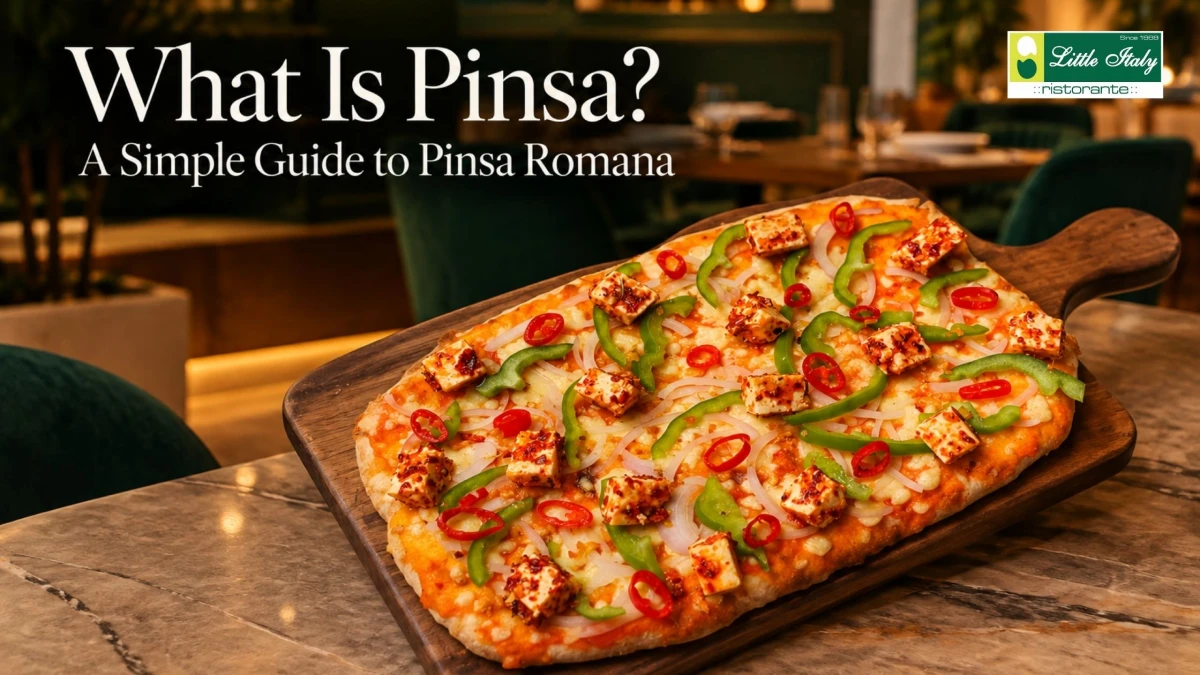
Pinsa is an Italian baked dish made with a specially prepared dough. Pinsa Romana is commonly associated with an elongated shape, a crisp outer layer and a soft airy center. It can look a lot like pizza at first, but the dough and the way it is prepared give Pinsa its own character.
If you have seen Pinsa on an Italian menu, you may wonder what makes it different from pizza. A big part of the answer is the dough. Pinsa is generally made with high hydration dough that is given time to develop before baking. This helps create its open, airy structure and crisp crust.
The toppings can vary too. Tomato and cheese work well on a simple Pinsa, while vegetables, mushrooms, paneer and other ingredients can give it a completely different flavor.
What Is Pinsa?
Pinsa is an Italian baked dish made from a specially prepared dough. The term Pinsa Romana is commonly associated with the style developed in Rome.
Modern Pinsa Romana is generally associated with Corrado Di Marco, who developed it in 2001. That detail is useful because the name can make Pinsa sound like an ancient Roman food. Modern Pinsa Romana is actually a relatively recent creation.
One of the defining features of Pinsa is its dough. It is made with relatively high hydration, meaning the dough contains a large amount of water compared with the flour. The dough also needs time to develop before it is baked. These factors play an important role in the final texture.
Pinsa and pizza naturally have a lot in common. Both can have a baked dough base, sauce, cheese and different toppings. The difference is in the dough, preparation and shape. So Pinsa is better understood as its own Italian dish rather than simply another type of pizza.
What Makes Pinsa Different?
Pinsa stands out because of a combination of shape, dough and texture. None of these features tells the whole story on its own.
Its Shape
Pinsa is commonly associated with an elongated or oval shape. The exact shape can vary depending on the preparation. The Pinsa Romana served at Little Italy Udaipur is described on the menu as rectangular.
Shape is easy to notice, but it is only one part of what makes Pinsa different. The dough and baking process have a bigger role in creating its familiar texture.
Its Dough
Pinsa dough is commonly made with a blend of flours and a relatively high amount of water. The exact recipe can vary between producers and restaurants.
The dough is also given time to develop before baking. This helps build the structure that allows Pinsa to have a light interior and a crisp outer layer.
Its Texture
The Pinsa crust is known for the contrast between its outside and inside. The outer part can have a crisp bite while the center remains soft and airy.
That contrast is one of the easiest ways to notice the difference when eating Pinsa.
What Is Pinsa Dough Made Of?
Pinsa dough is commonly associated with wheat flour, rice flour and soy flour along with water, salt and a fermentation ingredient. The exact ingredients and proportions can vary, so there is no single recipe that applies to every Pinsa.
The flour blend is an important part of the dough. Di Marco, which attributes the development of modern Pinsa Romana to Corrado Di Marco, describes its own Pinsa formulation as a blend of wheat, rice and soy flour with sourdough.
Water also plays an important role. Pinsa is known for high hydration, which means the dough contains a relatively large amount of water compared with the flour. Di Marco describes its original Pinsa dough as having around 80% hydration.
Fermentation is another part of the process. Giving dough time to develop allows its structure and air pockets to form before baking. The exact timing depends on the recipe and preparation method, so it is better not to treat one fermentation period as a rule for every Pinsa.
In simple terms, the flour blend, water and fermentation all contribute to the dough that gives Pinsa its distinctive baked texture.
Why Is Pinsa Crispy Outside and Light Inside?
The texture of Pinsa comes from several steps working together.
First, high hydration gives the dough a different structure from many standard doughs. Fermentation then gives the dough time to develop and form air pockets. When the dough enters a hot oven, the moisture and gases inside it expand. This helps create an open and airy interior.
The outside reacts differently to the heat. As moisture leaves the surface during baking, the outer layer becomes firmer and develops a crisp bite. The center retains more moisture, which helps it stay softer.
That is why a well-prepared Pinsa crust can give you two different sensations in the same bite: a crisp outside followed by a soft center.
The Little Italy menu describes its Pinsa Romana as having a crispy crunchy exterior and a light airy interior. The menu also mentions 80% hydration in its description of the Pinsa. This is a detail about the Pinsa offered by Little Italy and should not be treated as a fixed hydration level for every Pinsa recipe.
Is Pinsa a Flatbread?
Pinsa can broadly be described as an Italian flatbread, but flatbread is a much wider category. It can include many baked foods from different cuisines such as pita and naan.
Pinsa is more specific. It has its own dough style, preparation method and shape. Calling it a flatbread gives readers a quick idea of the type of food, but it does not fully explain what makes Pinsa different.
So, Pinsa can be called an Italian flatbread in a broad sense. The more useful description is an Italian baked dish made with a specially prepared, high hydration dough.
Pinsa vs Pizza: What Is the Difference?
Pinsa and pizza share many familiar features. Both can be made with a baked dough base and topped with ingredients such as tomato, cheese and vegetables. The main differences come from the dough, preparation and shape.
|
Feature |
Pinsa |
Pizza |
|
Shape |
Commonly elongated or oval |
Often round, but styles vary |
|
Dough |
Commonly made with high hydration |
Dough varies by pizza style |
|
Texture |
Crisp outside with a soft airy center |
Can range from soft to crisp |
|
Style |
Commonly associated with Pinsa Romana |
Includes many regional styles |
It is also important to remember that pizza does not have one universal style. Neapolitan pizza, Roman pizza and New York style pizza can all have different doughs, thicknesses and textures.
For that reason, saying that Pinsa is always lighter or crispier than pizza would be too broad. The actual result depends on the particular dough, recipe and cooking method.
The simple difference is that Pinsa has its own dough style and preparation method while pizza covers a much wider range of styles.
What Does Pinsa Taste Like?
The taste of Pinsa depends on both the base and the toppings.
The base has a mild baked flavor, while the toppings usually provide most of the character. Tomato and cheese can give a simple combination, while mushrooms, paneer, vegetables or spicy ingredients can create a stronger flavor.
The crust also affects the eating experience. A crisp first bite followed by a softer center gives Pinsa a different feel from a dense bread base.
This makes Pinsa toppings an interesting part of the dish. The same type of base can be paired with very different ingredients, so the final flavor can change quite a lot from one Pinsa to another.
Pinsa Romana at Little Italy Udaipur
Little Italy Udaipur includes Pinsa Romana on its menu with several topping options. The menu describes it as a pizza style from Rome and notes its rectangular shape, crispy crunchy exterior and light airy interior.
The menu includes Margherita Pinsa, Fiery Paneer Pinsa, Mexicana Pinsa and Truffle Mushroom Pinsa. It also lists Piccante Pinsa, Verde Pinsa, Garden Pinsa, Sicilian Pinsa, BBQ Pinsa and Napolian Pinsa.
These choices show how the same Pinsa base can be paired with different topping combinations. It also gives diners in Udaipur a chance to see how Pinsa Romana can fit into a wider Italian menu.
For someone searching for Pinsa in Udaipur, Little Italy is one place where Pinsa Romana is directly listed on the menu.
Conclusion
Pinsa is more than a different shape of pizza. Its dough, hydration, fermentation and baking method all play a part in the final result.
Pinsa Romana is the style associated with the modern Pinsa developed by Corrado Di Marco in 2001. Its combination of a crisp outer layer and soft airy center has become one of its most recognizable features.
So, when you see Pinsa or Pinsa Romana on an Italian menu, you can expect a baked dish built around a specially prepared dough and finished with toppings that can range from simple to more varied combinations.
